Acompanhe aqui a Resolução da Matriz de Inglês da 9ª classe 2025. Resumo completo e Explicado da Matriz de Inglês da 9ª classe do Ano Letivo de 2025

Acompanhe aqui a Resolução da Matriz de Inglês da 9ª classe 2025. Resumo completo e Explicado da Matriz de Inglês da 9ª classe do Ano Letivo de 2025
Acompanhe aqui a Resolução da Matriz de Inglês da 9ª classe 2025. Resumo completo e Explicado da Matriz de Inglês da 9ª classe do Ano Letivo de 2025 [Preparação para Exames Finais de 9ª classe 2025]
1- Reading skills
Reading is a process to read and understand what you are reading, which mean that if
you do not understand what you are reading , then you are not reading.
During a process of reading there are three principles stages that a student must follow
or obey in order to succeed in their reading skills:
1st- Pre-reading : This fisrt stage activacte prior knowledge, sets purpose, preview text
, usually using prediction or guessing.
Prediction means to guess the upcoming events or Language in text , depending on
context or diferent elements such as( images , charts and so on. ).
In that stages is used Skimming as a technique that may help readers to get general
information such as : Title, heading , first sentences , and also to read the first and last
paragraphs
2nd – While-reading or during reading : Engages with text through
Exames.Mozestuda.com MozEstuda.com
em: Exames.Mozestuda.com MozEstuda.com
decoding , questioning and predicting.
During reading skills a reader must highlight key points , ask Hw questions such as (
who?, what? , when? , why?,where,how, ..).
3rd- Post- reading: Reflects, Summarize ,Evaluates , and applies understanding.
After Reading a student must be able to : Identify the type of a text : knowing that there
different types and genres of text is crucial to know the type in order to effectivelly
Identify the components or elements of that text.
Identify specific information in a text : The technique that can be used to find specific
information in a text is scanning, used to find information such as key words, numbers
or phrases , and there’s no need to read the whole text , or everything , a student may
stop when He or she find the target.
Use inference: In a text inference means to use draw Conclusion that are not directly
stated but are logically supported by the information provided. In others words, An
inference is a Conclusion reached on the basis of evidence and reasoning.
Summarize the main idea of a text : a student must be able to paraphrase using own
Words the key purpose of a text or paragraph.
1.1. General Strategies of a n effective comprehetion of a text
1- Read the questions first: In order to know what to look for in the text .
2- skim the text: To get the main idea before diving into details.
3- highlight Key points :using scann which focus on names , dates and definition.
4- Read carefully: pay attention to tone, connectors , punctuation marks…
5- Paraphrase: answer In you own words , avoiding copying unless aske to quote.
6- Use evidence: Support answerS with phrases or ideas from text.
7- Review your answer: Ckeeck if your answer is clear , coherent and conhensive .
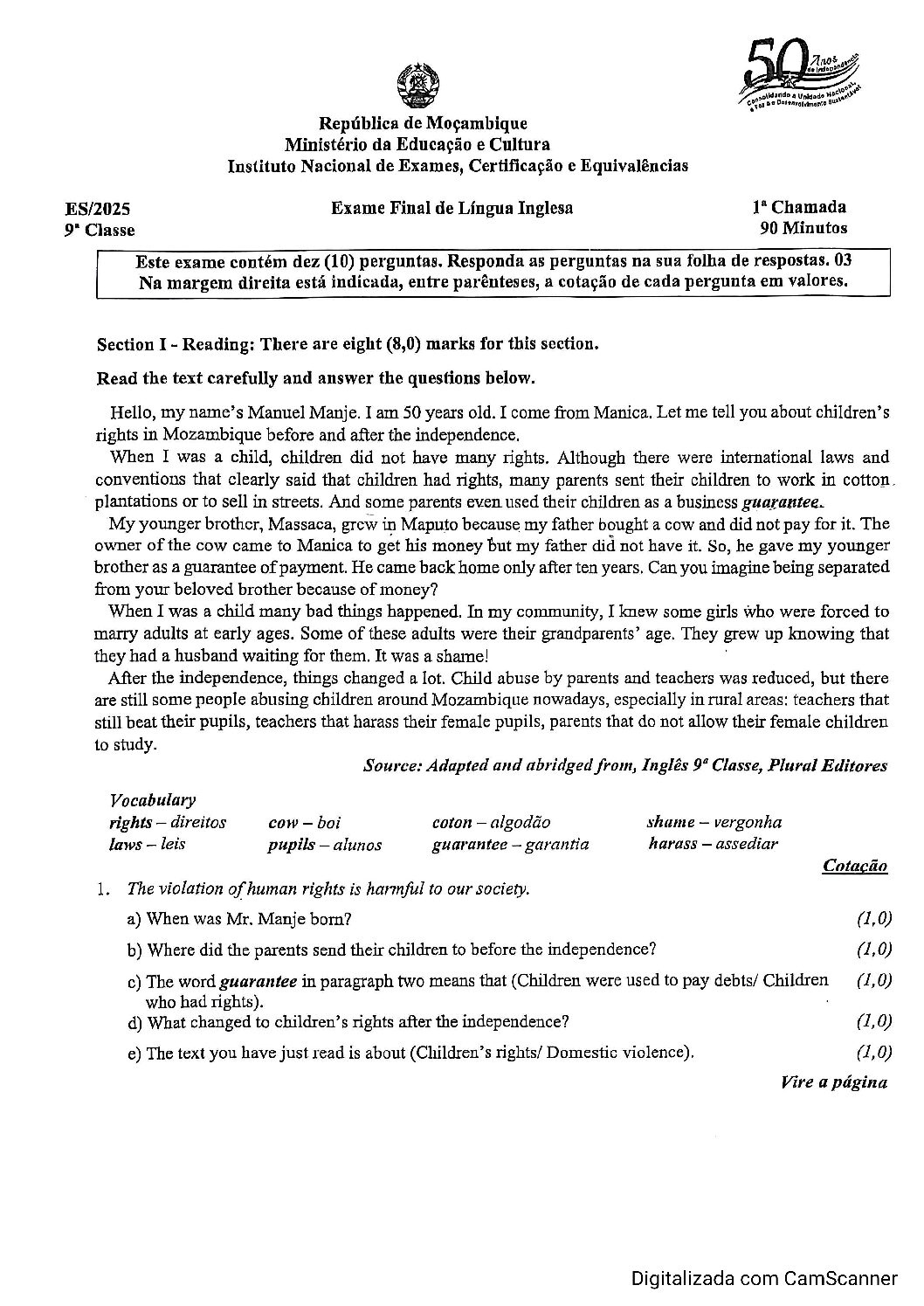
1.3.Practical example of comprehension and Interpretationof a text . Human Rights
and gender.
Human Rights are a set of rights that are given to every human being regardless of
his/her gender, caste, creed, religion, or nationality. These rights include freedom of
Exames.Mozestuda.com MozEstuda.com
em: Exames.Mozestuda.com MozEstuda.com
speech, expression, religion, etc. These rights are very essential for the proper and
harmonious development of an individual. These rights are universal and every person
is entitled to these rights. No one can be denied these rights.
Basic human rights include the right to life, liberty, and freedom. These rights are
protected by law and are considered fundamental for the existence of human beings.
Human rights also include the right to education, right to work, right to
equality, and right to live with dignity. These rights are necessary for the overall
development of an individual and for the progress of society.
Human rights are protected by law and are enforced by the government. People can seek
justice if their rights are violated. There are various national and international
organizations that work for the protection of human rights. These organizations create
awareness among people about their rights and help them to fight against injustice.
In conclusion, human rights are very important for the well-being of individuals and
society. They help in creating a just and equal society where every person is treated with
respect and dignity. It is the duty of every individual to respect the rights of others and
to work towards the protection of human rights.
Comprehension And Interpretation of the text .
Answer the following questions about the text above correctly In clear way and avoiding
misinterpretation.
1-According to the text , what are human rights?
2-which are the basic human rights based on the text?
3-Who Is responsible for protecting and enforcing human rights, according to the text?
4-what roles do national and international organizations play in human rights?
5-what is the main conclusion of the text regarding human rights?
Answers
1- A – The text defines human rights as a set of rights given to every human being
regardless of, caste, creed , religion or nationality.
2- A- The text lists basic human rights such as the right to Life, liberty, Education , work,
Exames.Mozestuda.com MozEstuda.com
em: Exames.Mozestuda.com MozEstuda.com
equality and dignity .
3-A- The text states that human rights are protected by law and enforced by the
government .
4-A- According to the text, these organizations raise awareness about human rights and
help people fight against injustice.
5-A- the text concludes that human rights are vital for individual and society well-being
, helping to build a just and equal society.
NB: To interpret this text , we used scanning to get specific information or key points or
words.
Q1: the key words are:human rights
Q2: basic human rights
Q3:protecting and enforcing..
Q4: National and international organizations
Q5: Conclusion.
2- Importance Of Human Rights And Gender Education
1- Human rights education are essential for empowering individual to know ,
understand, and defend their rights.
2- It fosters respect for diversity and promotes equality among all individual.
3- This education helps create a culture of tolerance , empathy and respect of other’s
rights and freedoms.
4- Human rights education are vital in preventing discrimination , violence and
injustices.
5- It raises awareness of universal rights and responsibilities.
6- Equips individual with the knowledge and skills needed to advocate for justice and
equality.
Exames.Mozestuda.com MozEstuda.com
em: Exames.Mozestuda.com MozEstuda.com
7- Contributes to building a more inclusive, justice and peaceful society .
8- Ensures everyone’s rights are respectedand protected.
9- Play a crucial role in promoting a culture of human rights.
10-Encourages active participation in democratic process.
11-Support The development of a global community committed to human rights
principles .
Human rights are foundational Freedom and protection that belong to every single one
of us , regardless of : Race, gender , sexuality, Religion or beliefs , because all human
beings are born free and equal in dignity and right and freedom of opinion and
expression , rights to education, healthcare, and others social services , and no person or
entity can ever take these
rights away from you , it means that everyone can make choices about their own lives ,
their are justice, freedom and equality and all are your rights.
3- Part Of Grammar- Present Simple VS Past simple ( Affirmative, Negative and
Interrogative forms).
Future: Will VS Going to. Modals
Degrees Of comparison Conditionals.
3.1- Present Simple VS Past simple (Affirmative,Negative and Interrogative forms)
3.1.1- Present Simple:
The Present Simple tense is one of the most commonly used Verbs tense in english, it
describes actions or states that are general truths , habits , and routines.
3.1.2- General Structure : SUBJECT + VERB + OBJECT. Eg.: I eat banana .
We have the subject which is “I” , The Verb to “eat” then the Object “banana “.
3.1.3 Structure of Affirmative forms
: Subject +Verb + Object
Eg.: She cooks beans.
Exames.Mozestuda.com MozEstuda.com
em: Exames.Mozestuda.com MozEstuda.com
The Subject is “She”the verb is “Cook” and for all third person in Singular we usually add
“S or ies” depending on verb , if it is or not regular verb ( +s =she works , +ies = Cries ,
usually when the Verb end with ‘Y’ , ) , and we also have the Object “beans “.
Eg.: I play volleyball
It smell good.
I go to school.
3.1.4- Structure of Negative forms :
SUBJECT + AUXILIAR VERB (do) +NOT + BASE VERB + OBJECT.
Eg.: I do not Cook beans or I don’t cook beans .
We have “I” as a Subject, “do” as auxiliar Verb , “not” it determines the Negative form ,
then we have “ Cook “ as the mean or base verb , and “beans” as object.
Eg.: I do not play volleyball .
It does not smell good. I do not go to school.
3.1.5 Structure of Interrogative form:
AUXILIAR VERB + SUBJECT + BASE VERB + OBJECT.
Eg.: Do i cook beans ?
we usually change the position of the Auxiliar Verb and Subject , and this Sentence also
obey the structure, let us analyze .
“Do” is the auxiliar verb, “I” Subject , “Cook “ base verb ,and “beans” is the object
3.1.6- Past simple
: The past simple tense describes actions that happened in the past and are now finished.
It is used for events with a clear time reference, even if that time is not stated directly
3.1.7- Common Time Markers
Yesterday .
Last week/month/year . Two days ago .
Exames.Mozestuda.com MozEstuda.com
em: Exames.Mozestuda.com MozEstuda.com
In 2010 .
When I was a child
3.1.8-Structure of Affirmative (positive):
SUBJECT + PAST VERB (ed) + OBJECT
I cooked beans.
We have “I” as the subject ,”cooked “ regular verb in past , and “beans” as the object.
There cases that we can find Irregular verbs such as : go= went ,
eat = ate
so the end “ed” is used for regular verbs like: cook = cooked
need= needed, help= helped
we can also find verbs that end with just “ d” like love= loved
Hate= hated like= like
and verbs that end with ied =y , like : Cry = Cried
justify = justified , and fry = fried
3.1.9 – Structure of Negative form:
SUBJECT +PAST AUXILIAR VERB (DID) + BASE VERB+ OBJECT
Eg.: I did not cook beans or I didn’t cook beans. The sentences followed the structure .
Eg.: I did not go to school .
It didn’t smell good.
3.1.10- Structure of Interrogative form:
PAST AUXILIAR VERB + SUBJECT +BASE VERB+OBJECT
Eg.: Did I cook beans?
Exames.Mozestuda.com MozEstuda.com
em: Exames.Mozestuda.com MozEstuda.com
Did i go to school yesterday? Dit it smell good?
Difference between present simple and past simple
Tense Present Simple Past simple
Functions Describes habits, routines,
and general truths, using tha
base verb or base +s
Describes actions that
appened in the past and arenow
finished.
General
Structure
Subject + base verb (present)
Subject + base Verb(past)+Object
Examples I like tea I liked tea
3.2 -Future will and Going to :
3.2.1-Will
: Used for spontaneous decisions, promises, offers, and predictions without clear
evidence.
Eg.: I will call you later.
Often chosen at the moment of speaking. Spontaneous decision: “I’ll get the door!”
Promise or offer: “I’ll help you with your project.”
Prediction (without evidence): “I think it will be a great movie.”
3.2.2- Going to: Used for planned actions or predictions based on current evidence.
Eg.: I am going to visit my aunt next week. Shows intention or something already
decided. Another’s examples :
Planned action: “I’m going to visit my aunt next weekend.”
Intention: “He’s going to study engineering.”
Prediction (with evidence): “Look at those clouds. It’s going to rain soon.”
Key Difference:
“Will” is more spontaneous or uncertain.
Exames.Mozestuda.com MozEstuda.com
em: Exames.Mozestuda.com MozEstuda.com
“Going to” is more intentional or based on present signs.
3.3- Modals verbs
Modal verbs are special auxiliary verbs used to express ability, possibility, necessity,
permission, or obligation. They help modify the meaning of the main verb and show the
speaker’s attitude or intention.
Common modals verbs
Can : ability or permission She can speak four languages. Can I go outside?
➢ Could : past ability or polite request
I could swim when I was five. Could you help me, please?
➢ May : permission or possibility
You may leave now.
It may rain later.
➢ Might : weaker possibility
We might go to the beach.
➢ Must : strong obligation or logical conclusion She must be tired after the trip.
➢ Shall : formal suggestion or future (mostly British English) Shall we begin?
➢ Should : advice or expectation You should study for the exam.
He should be home by now.
➢ Will : future or certainty I will call you tomorrow.
➢ Would : polite request or hypothetical
I would travel more if i had money. Would youlike some tea?
They do not change form (no -s, -ed, or -ing), and they are always followed by the base
form of the verb.
Eg.: Can go , should study, might eat. And so on.
3.4 – Degrees of comparison
: Degrees of comparison are grammatical forms used to compare one thing with another.
Exames.Mozestuda.com MozEstuda.com
em: Exames.Mozestuda.com MozEstuda.com
They apply mainly to adjectives and adverbs, helping us express differences in quality,
quantity, or manner. There are three degrees:
3.4.1. Affirmative Degree
: Describes a quality without any comparison.
Eg.: She is tall. He runs fast.
3 .4. 2. Comparative Degree
: Compares two people, things, or actions. Usually formed by adding -er or using
more/less.
Eg.: She is taller than her brother.
He runs faster than me .
She is more intelligent than her collegues.
In comparative Degree the sufix “er” is used for short words or items , such as : tall , big,
small, fast and so on.
On the other hand, we add “more” for long words like: intelligent, beautifull, interesting,
and so on .
3.4.3. Superlative Degree
: Compares three or more items, showing the highest or lowest degree. Formed by
adding -est or using most/least.
Eg.: She is the tallest in the class.
He runs the fastest of all.
This is the most interesting book ,I have to read.
In Superlative Degree the sufix “est” is used for short words or items , such as : tall , big,
small, fast and so on.
On the other hand, we add “most” for long words like: intelligent, beautifull, interesting,
and so on .
3.4- Conditionals Sentences : Conditionals are sentence structures used to express
situations that depend on a condition. They often use the word “if” to introduce the
condition, followed by a result.
3.4.1- Zero Conditional: Used for facts, rules, or things that are always true.
Exames.Mozestuda.com MozEstuda.com
em: Exames.Mozestuda.com MozEstuda.com
Structure: If + present simple, present simple
Eg.: If you mix red and blue, you get purple.
3.4.2- First Conditional : Used for real and possible future situations.
Structure: If + present simple, will + base verb
Eg.: If it rains tomorrow, we will cancel the picnic.
3.4.3- Second Conditional : used for unreal or unlikely situations in the present or
future.
Structure: If + past simple, would + base verb
Eg.: If i were rich , I would buy a house by the sea.
3.4.4- Third Conditional : Used for imaginary situations in the past (things that didn’t
happen).
Structure: If + past perfect, would have + past participle
Eg.: If she had studied harder, she would have passed the exam.
4- Expression used to write a effective text or composition. 4.1- Sequencing /
Order
Purpose: To show the order of ideas, actions, or steps.
Use: Common in instructions, narratives, and structured arguments.
Function: Helps the reader follow a logical flow.
Eg.: First, we analyze the data. Then, we interpret the results
Exames : First , First of all ,To begin with ,Second , Third ,Next ,Then , After that ,Before
,Earlier ,Meanwhile ,Later ,As soon as , By the time ,Until , Finally , In the end ,Lastly , At
the end .
4.2 Addition
Purpose: To add more information or reinforce a point.
Use: Expands or supports an idea.
Exames.Mozestuda.com MozEstuda.com
em: Exames.Mozestuda.com MozEstuda.com
Function: Builds depth and coherence.
Eg.: The theory is well-supported. Moreover, it aligns with recent findings.
Examples: And , Also , Moreover , Besides , In addition , Additionally , As well
as ,Another point , Another factor ,What is more , To further strengthen this view
4.3- Contrast / Concession
Purpose: To show differences or acknowledge opposing views.
Use: Highlights contradictions or exceptions. Examples: However, Although, Yet,
Despite Function: Adds nuance and critical thinking.
Eg.: Although the method is effective, it’s not widely used.
But , However , Although , Though , Even though ,Despite , In spite of , Whereas ,On the
other hand ,Yet , Apart from
4.4-Purpose
Purpose: To explain the intention or goal behind an action.
Use: Often used in persuasive or instructional writing.
Function: Clarifies motivation or objective. Eg.: She studied hard in order to pass the
exam Examples: To, So that, In order to .
4.5- Consequence
Purpose: To show the result or effect of something.
Use: Connects cause and outcome
Function: Strengthens logical connections.
Eg.: He missed the deadline. As a result, the project was delayed Examples: So ,
Therefore , Thus ,As a result ,Consequently ,Eventually . 4.6-Opinion
Purpose: To express personal views or beliefs. Use: Common in essays, discussions, and
debates. Function: Signals subjective perspective.
Eg.: I believe this policy will improve education
Examples: In my opinion ,As far as I’m concerned ,To my mind , I think , I believe
Exames.Mozestuda.com MozEstuda.com
em: Exames.Mozestuda.com MozEstuda.com
4.7- Explanation
Purpose: To clarify reasons or causes.
Use: Supports arguments or justifies actions.
Function: Makes reasoning explicit.
Eg.: He left early because he felt sick
Examples: Because , Since , As ,For , The reason why
4.8- Condition
Purpose: To express a requirement or possibility. Use: Often used in hypothetical or
logical statements. Function: Sets limits or triggers.
Eg.: You can join the trip if you finish your workExamples: If , Provided that ,As long as,
Unless , Whether
4.9- Choice
Purpose: To present alternatives or options. Use: Useful in decision-making or
comparisons. Function: Offers flexibility or contrast.
Eg.: You can choose tea or Coffee
Examples: Or , Either … or ,Neither … no / Concession ,Whatever ,Whenever and so on.
👇👇 Baixar o Documento Completo em PDF Aqui👇👇